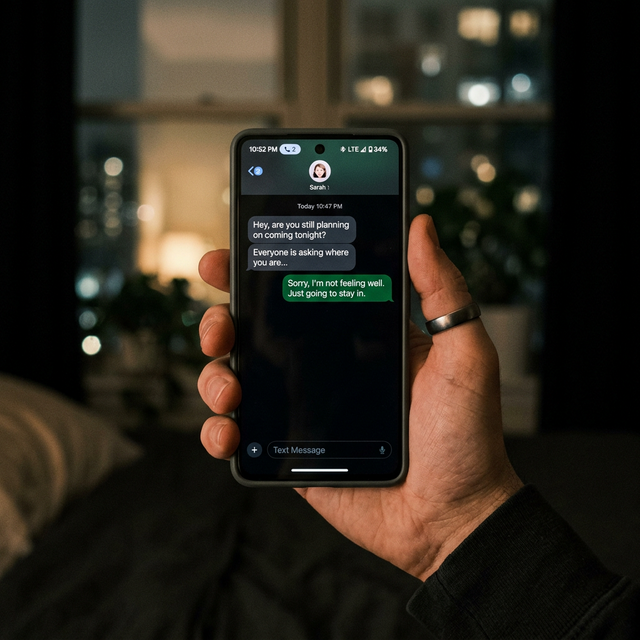
What Does ATM Mean?
A message that says "can't talk ATM" is almost never about a cash machine. In texts, group chats, and social posts, ATM usually means "at the moment."
It is a short time marker for what the sender is doing or feeling right now.
Examples of ATM in Texting
- Example 1: "I'm finishing maths homework ATM. Can I call after dinner?"
- Example 2: "ATM we're waiting for the bus, so we may be ten minutes late."
- Example 3: "Not feeling up to gaming ATM."
Other Meanings to Watch For
ATM can carry an explicit meaning in sexual conversations, but the acronym by itself proves nothing. Check the words around it, who sent the message, and whether the exchange contains other sexual language. In an ordinary school or family chat, "at the moment" is by far the more sensible reading.
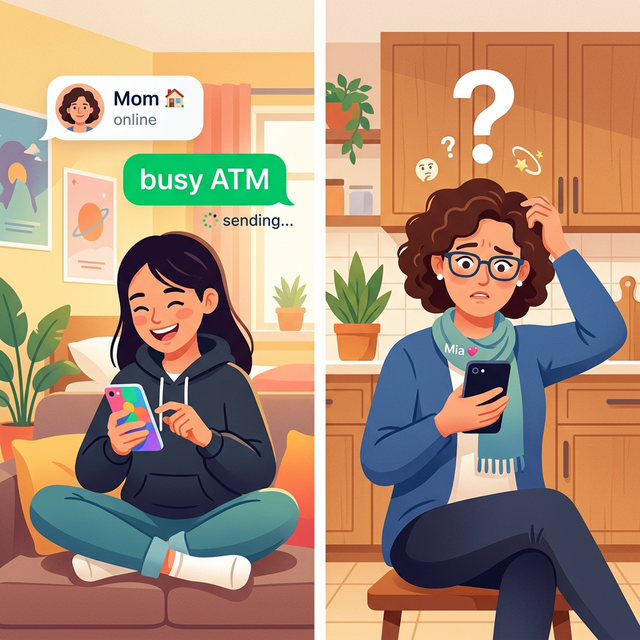
One acronym can look alarming when it is pulled out of a longer, harmless conversation.
Context matters more than the acronym
If your family uses monitoring tools, agree on what will be reviewed and why. A single slang term is not evidence of risky behavior.
Review parental-control optionsThe Parent Angle: Slang, Conflict, and Clarification
The fastest way to turn a harmless message into an argument is to decide what it means before asking. I have found that reading one message above and below the acronym usually settles the question. If it does not, ask without treating the child as if they have already done something wrong.
How to Ask for Clarification
Keep the question short and give your child room to correct you. This works better than opening with a warning or demanding the phone.
Try: "You wrote 'can't ATM.' Does that mean 'at the moment,' or something else in this chat?"
Avoid: "Why are you using secret codes? Who are you talking to?"

A calm question preserves trust and usually gets a clearer answer.
Set the rules before reviewing a phone
Explain which safety concerns justify a check, what stays private, and when the arrangement will be reviewed again.
Compare available toolsNext Steps for Ethical Parenting
Learning common shorthand gives you a useful baseline, not a reason to read every conversation. If your family uses parental control features, discuss the boundaries first. Reserve tools such as keyword blocking for specific, agreed safety concerns rather than ordinary day-to-day chat.
For more examples, use our Teen Slang & Emoji Dictionary as a reference, then ask your child how the term is used in their own friend group.