Introduction
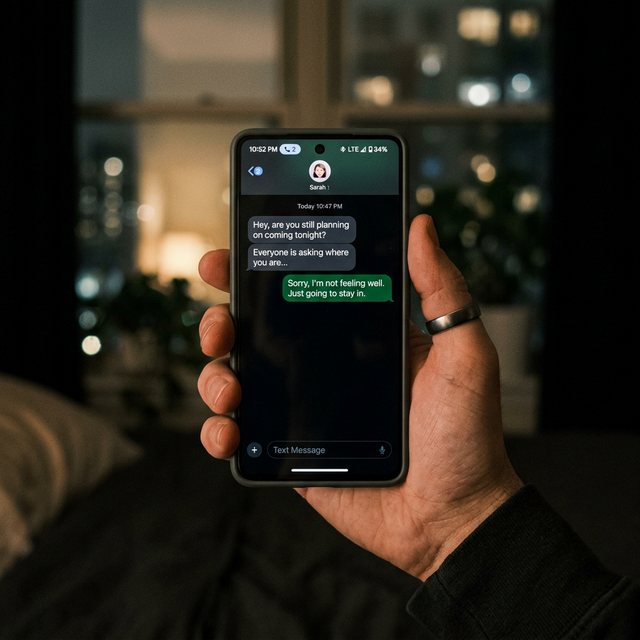
A three-letter message can look suspicious without the ten messages around it. Meanings shift between friend groups, and a suggestive emoji may be a joke about food in another exchange. Use this dictionary to form a question, not deliver a verdict.
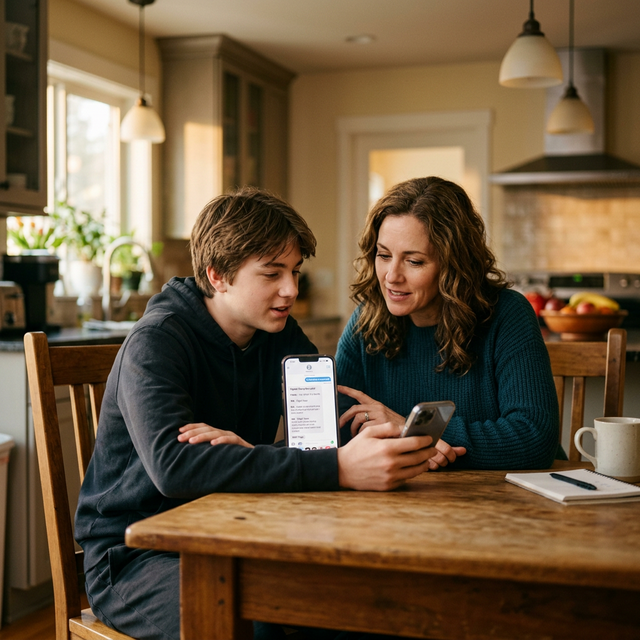
Ask what a term means in your child's group before relying on a dictionary definition.
The risk labels below are prompts, not a scoring system. I first check the sender, surrounding messages, signs of pressure, and any change in offline behavior.
How to Use This List
Do not try to memorize the page. Search for a term when it appears, read several messages around it, and ask your teenager how their friends use it. Repetition, secrecy, threats, requests for images, and sudden changes in mood deserve more attention than one unfamiliar abbreviation.
If your family has agreed to technical controls, our guides cover setting up keyword blocking and creating keyword alerts. Keep alerts narrow. Broad lists produce false alarms and can turn normal conversations into constant surveillance.
Use alerts for specific safety concerns
Agree on the terms that justify an alert, who can review it, and when the rule will be reconsidered.
Review parental-control options1. Secrecy Signals
Teenagers need some privacy. These terms announce that a parent is nearby; they do not reveal the subject. Pay attention when they appear beside threats, secret meetings, or requests to delete messages.
POS (Parent Over Shoulder)
Risk Level: Context-Dependent
What it Usually Means: A parent is close enough to see the screen, so the sender wants the other person to pause a private subject.
What it Can Mean: Often it protects gossip or a surprise. In a concerning exchange, it may signal a subject the participants know is unsafe.
Example: "Can't talk right now, POS."
What to Say: "I know POS usually means a parent is nearby. You are allowed private conversations, but I want you to tell me if someone is pressuring you to keep a dangerous secret." If you want the short version of this, How to Get a Copy of a Child's Text Messages is the place to start.
Deep dive: Read our full guide on What Does POS Mean in Text?
CD9 (Code 9)
Risk Level: Context-Dependent
What it Usually Means: A warning that a parent or another adult is nearby. Some groups use different numbers, so confirm rather than assume.
9 / 99
Risk Level: Context-Dependent
What it Usually Means: In some chats, 9 means a parent entered the room and 99 means the parent left. These codes are not universal.
2. Bullying and Harassment
Repetition, a power imbalance, a group pile-on, or ignoring requests to stop can turn banter into harassment.
KYS (Kill Yourself)
Risk Level: Red Flag
What it Usually Means: A hostile instruction used as an insult. Treat it seriously even when the sender later claims they were joking.
What to Say: "I saw KYS in this conversation. First, are you safe? Then we need to save the message, block or report the account if appropriate, and talk about what happened before it was sent." That is the question How to Monitor Teenager Texting Habits answers in more detail.
Roast
Risk Level: Harmless to Context-Dependent
What it Usually Means: Friends teasing one another with exaggerated insults.
What it Can Mean: It stops being mutual when one person cannot opt out, the comments target a vulnerability, or the exchange follows them across accounts.
3. Sexual Content and Sexting
Emojis alone are poor evidence. Focus on requests for intimate images, age differences, threats, pressure, and attempts to move the chat elsewhere.
🍆 (Eggplant) & 🍑 (Peach) & 💦 (Sweat Drops)
Risk Level: Red Flag (in certain contexts)
What it Usually Means: In sexual exchanges, these can represent genitals, buttocks, or sexual activity. In food, sport, or joke threads, they may be literal or harmless.
What to Say: "Some emojis can be sexual. Has anyone asked you for a picture or made you uncomfortable? You will not be in trouble for telling me."
Nudes / Send Nudes
Risk Level: Red Flag
What it Usually Means: A request for an intimate image. Do not forward the image or create another copy. Preserve the conversation details and seek appropriate local guidance if a minor is involved.
4. Substances (Drugs & Alcohol)
Drug slang varies by group. A symbol matters more beside prices, quantities, payment details, or a meeting place.
🍃 (Leaf) or 💨 (Dash/Smoke)
Risk Level: Red Flag
What it Usually Means: These may refer to cannabis, vaping, or smoke, but they also appear in ordinary discussions about weather and nature.
Plug
Risk Level: Red Flag
What it Usually Means: A person who can supply something, sometimes drugs or counterfeit goods. It can also mean a recommendation or promotion.
What to Say: "When you say plug here, do you mean a seller or just a recommendation? Has anyone asked you to pay, meet, or keep a purchase secret?"
5. Mental Health and Self-Harm
Do not diagnose distress from slang. Ask whether your child feels safe. For immediate danger, contact local emergency services. In the US and Canada, call or text 988.
Yeet (in specific contexts)
Risk Level: Context-Dependent to Red Flag
What it Usually Means: Usually it means throwing something or is simply an excited joke. Do not treat "yeet" as a self-harm code without clear surrounding evidence of distress.
"I’m tired" / "Done" / "Barcodes"
Risk Level: Red Flag
What it Usually Means: "Tired" and "done" are ordinary words. Repeated hopeless statements, withdrawal, or references to "barcodes" alongside injuries or self-harm discussions deserve a direct safety check.
What to Say: "You have said you're done several times, and I am worried. Are you thinking about hurting yourself? I can listen, and we can get help together."
Why This List Goes Stale, and How to Read a Message It Doesn't Cover
Every entry on this page was current when it was written, and some of them will be wrong within a year. Slang rotates for the same reason passwords do: the moment adults learn a word, it stops being useful for keeping a conversation private. Expect the vocabulary to drift from acronyms toward single letters, emoji and inside jokes that mean nothing outside one friend group, and expect a child to be annoyed rather than evasive when you quote a dictionary at them.
So treat the list as a starting point and the message as the evidence. When a term appears that is not here, the same four checks take about a minute:
- Who sent it. A saved contact in a group of six reads differently from an unknown number in a one-to-one thread.
- What came immediately before. A question, a request for a photo, a price, or a meeting time changes what the next word means.
- What came after. "Delete this", "don't tell", "my parents are here", a time and a place: those lines matter more than the abbreviation itself.
- What changed offline. New secrecy about the screen, a second phone, sleeping badly, going quiet after a notification.
A worked example. An unknown number sends "u up", then "wb", then a money emoji. The dictionary is technically right that WB means welcome back, but the useful reading is that someone is re-opening a conversation with a payment reference attached, which is a question about the sender rather than about the word.
The habit worth avoiding is opening with the definition. Saying "I looked up plug" tells a teenager that the list is the threat model, and the next conversation moves to a word that is not on it. Ask about the situation and keep the list in your pocket. If the conversation itself is the hard part, our guide to talking to teens about parental control has scripts for it.
The Same Emoji Means Something Different Depending on Where It Was Posted
Most of the entries above are written as if a symbol has one meaning. In practice the meaning moves with the surface it was posted on, and that is where a lot of parental worry goes wrong. A peach emoji under a friend's beach photo in a public comment is a joke about the photo. The same peach in a one-to-one message at eleven at night is a different sentence entirely. Before a symbol becomes evidence, the question to ask is not "what does it mean" but "where did it appear".
The surfaces behave differently, and each one changes who can see the message. A public comment sits under someone else's post, so it is written for an audience and usually performed for one. A story reply is private to the person who posted the story, which makes it a conversational opener rather than a public joke. A group chat of three and a group chat of thirty have completely different social pressure inside them; the same words that are funny in the small one are a dare in the big one. A direct message is the only one of the four with no audience at all, which is exactly why the riskier exchanges tend to move there after a public joke lands well.
Some emoji are not messages at all. Snapchat generates the yellow heart, the hourglass and the fire next to a name itself, based on how often two accounts have exchanged snaps, so a heart in that position describes the app's own counter rather than anything your child typed. Reaction taps, the double-tap on a message, carry a whole reply with no characters in them. Skin-tone modifiers and small character sequences read as one symbol to an adult scanning a screenshot but as a specific reference to a teen. When you are looking at a picture of a message rather than the message, you are already missing the surface, the sender and the two lines before it.
That is the practical rule this dictionary keeps pointing at: a screenshot crops exactly the information that decides the meaning. If something worries you, ask where it was posted rather than what it means, and ask to see the thread rather than the symbol. For the app where this matters most, the message itself disappears by design, so seeing Snapchat messages safely is a different job from decoding them. A one-line answer about platform and context is usually worth more than a perfect translation.
Common Abbreviations Deep-Dives
Use these pages when you need more examples for a specific acronym:
- LMK Meaning in Text (Let Me Know)
- HMU Meaning (Hit Me Up)
- IIRC Meaning in Chat (If I Recall Correctly)
- GTG Meaning in Text (Got To Go)
- WB Meaning in Text (Welcome Back)
- OTP Meaning in Text (On The Phone / One True Pairing)
- ATM Meaning in Chat (At The Moment)
Changelog: New Slang Alerts (Updated Monthly)
- March 2026: Clarified the limits of interpreting "Barcodes" without context.
- February 2026: Added the non-drug meanings of "Plug" to reduce false alarms.
- January 2026: Published the first 2026 edition of this reference.
Context beats a keyword list
If your family uses a parental dashboard, explain what it collects and review only the information needed for an agreed safety concern.
Compare parental dashboardsReview our parental control features and legal use policy before using monitoring tools. Laws and consent requirements differ by location and the child's age.