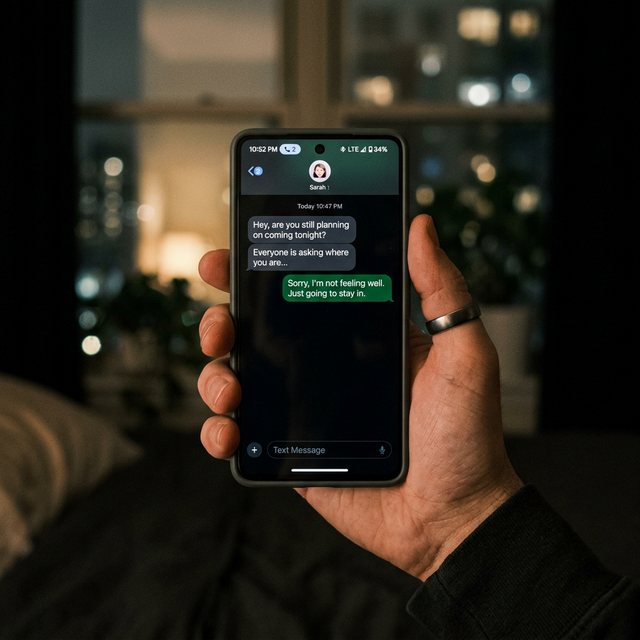
What Does GTG Mean?
GTG stands for "Got To Go."
It is one of the oldest texting acronyms, and it simply means the sender has to leave the conversation. A common variation is G2G.

A sudden GTG often means the sender is rushed or suddenly busy.
How Teens Use GTG (With Examples)
GTG is a polite and efficient way to sign off from a digital space.
- Example 1: "Dinner's ready, GTG."
- Example 2: "My mom is making me do chores. GTG, talk tomorrow!"
- Example 3: "GTG ttyl" (Got to go, talk to you later)
Messaging Etiquette Tips
Ending chats politely is a learned skill. A sudden GTG can sometimes feel abrupt or dismissive.
- The Polite Sign-off: Explain why you have to go (e.g., "GTG my phone is dying").
- The Avoidance Sign-off: Sometimes a sudden "GTG" with no warning means the person is uncomfortable with the conversation topic and wants a quick escape.
GTG in a Real Parent-Teen Thread
Most parents meet "GTG" in a family chat rather than in a friend's conversation, and that changes what the word is doing. From a teenager to a friend it can be an exit from a topic. From a teenager to a parent it is usually environmental: something in the room is pulling them away.
Parent: "Practice finished?"
Teen: "yeah, waiting for Jake's mum"
Parent: "ok. home by 6?"
Teen: "gtg"
That "gtg" is not a refusal to answer the question. It means "I am being moved into a car, a changing room, or a conversation with an adult, and I will answer in a few minutes". The reply that keeps the thread useful is a short one: "ok, let me know when you're free" — not a second question, and not the "?" that turns a delay into a standoff.
The opposite pattern matters just as much. When GTG arrives immediately after a tense exchange it is often a de-escalation move, and a decent one: the teenager is ending a conversation that is going badly instead of escalating it. Sending three more messages into that gap teaches them that the only way to close a chat is to stop replying, which is the habit you least want them to learn.
Position also decides meaning. "We're gtg at six" is good to go — ready — and that reading only works when the word follows "we're" or "they're". A bare GTG at the end of a message, especially followed by "ttyl", is a sign-off, and a quick "night" is a complete answer. If the same three letters keep landing in the middle of practical questions, the fix is a written rule about check-ins rather than a debate about slang; our guide to shared family phone guidelines covers how to set one that survives a real week.
Is It Just An Excuse?
Sometimes "GTG" is used to escape bullying or uncomfortable conversations. Get alerts when they use risky terms and view the full context.
See Their Actual TextsGTG and Its Lookalikes: G2G, BRB, BBL and GTS
Most confusion around GTG doesn't come from GTG. It comes from the four or five abbreviations sitting beside it in the same thread, close enough to blend together on a lock-screen preview. On a phone you often see the letters without the sentence, so a parent who knows one of them and not the others can read a whole conversation wrong in good faith. Here are the neighbours, what each one commits the sender to, and how the thread usually continues afterwards.
| Acronym | What it stands for | What it actually commits to |
|---|---|---|
| GTG / G2G | Got to go / good to go | Leaves in a moment. G2G is the gamer spelling and is often a green light ("ready, go") rather than an exit - the one lookalike that can mean the opposite of leaving. |
| BRB | Be right back | A pause with a return attached. The shortest exit in the set and the one that makes a promise the sender usually keeps. |
| BBL | Be back later | A longer exit with no clock on it. "Later" is the whole of the information, so nothing downstream should depend on it. |
| GTS | Going to sleep | Ends the night. Rarely a brush-off - it usually arrives after a long exchange, as the last line. |
| GG | Good game | Not a goodbye at all. It closes a round in a game; outside gaming it is unusual enough to be worth a second look. |
The practical difference is what each one lets you expect. GTG and BRB both imply a return, so a thread that ends on either is paused rather than dead - the next message tends to open with WB (welcome back) or jump straight back into the topic. BBL is the one that quietly ends things: it is what a teen types when they mean to leave and don't want to explain. GTS is the cleanest exit of the lot and the least worth reading anything into. If a thread ends on GTG and the next thing you see is a different app, that is not evidence of anything - it is what GTG is for.
Two patterns do carry information. First, "gtg" arriving mid-sentence with no explanation is usually a genuine interruption: someone at the door, a parent calling, a match starting. Second, "gtg" followed by silence and then a completely fresh topic hours later is a topic that got dropped, not a person who got upset. Both read identically on a preview and completely differently in a transcript, which is why a keyword alert on "gtg" tells you so little on its own. A thread that comes back with WB (welcome back) is a thread between people who expect to keep talking; a thread that stops after BBL is one that may not.
Parent Guidance: The "GTG" Conversation
GTG is completely safe and harmless. However, parents can use their knowledge of slang to start open dialogues rather than policing their kids' language. Learning your teen's vocabulary helps you understand their digital world without spying.
Building Trust
Rather than demanding to see their phone every time they type "GTG," establish a baseline of trust. Have a trust conversation: "I understand that you have your own life and private conversations on your phone. If you ever feel uncomfortable in a chat, it's totally okay to just type 'GTG' and log off, and you can always come to me for help."
If you're establishing device rules, rely on ethical tools like keyword blocking to catch concerning content, while allowing safe words like "GTG" to flow freely.
Check out our Teen Slang & Emoji Dictionary to learn the differences between harmless slang and high-risk phrases.
The Group Exit: Leaving a Thread Without Leaving the People
A gtg to one friend is a pause. A gtg in a group of eight is an announcement, and teenagers know the difference better than the adults reading over their shoulder.
That is why most exits from a group happen without the word at all. Muting a chat, turning notifications off, or simply putting the phone down leaves the group and the friendship intact, which is what a teenager usually wants after a long day or a sharp exchange. Leaving the group outright is a statement, and it is saved for the friendships that are actually ending. A chat that has gone quiet is usually a mute, not a falling-out, and reading it as the second is how a parent escalates something that was already resolved.
The ritual version matters too. Six people typing gts in sequence at half past eleven looks alarming in a screenshot and means nothing at all: it is a group closing the evening in the order they always do. The pattern that carries information is the exception - the one person who leaves early, three nights running, or the gtg that lands in the middle of a thread that was turning unpleasant.
For that second one, the useful move is to make the exit legitimate rather than to interrogate it. A child who has been told out loud that leaving a bad conversation is allowed, and that they can tell one person afterwards, will take the exit and then talk to you. A child who expects a cross-examination stays in the thread and absorbs it. The late-night version of this is also the part that costs sleep, which is what our guide to phones and restful nights is really about.
When the GTG Stops Coming: Sign-Offs as a Household Barometer
Most families end up with a ritual they never agreed to: the goodnight gtg. It arrives at half past ten, it is usually spelled badly, and it is often the only unprompted message a parent gets from a teenager all day. That is exactly why its disappearance is noticed so sharply.
It is also why it should not be read as an alarm. A gtg that stops can mean three things, and only one of them is a worry. The chat moved - the sign-off now happens in a group where a parent is not present. The sign-off became unnecessary - the child started coming downstairs again, or the phone now charges in the kitchen and the conversation moved with it. Or something changed that the ritual was carrying, which is the version that matters and the version that a single silent night cannot establish.
Three weeks is a better sample than three nights. Count how often the sign-off arrives, then check the two things that are not on the phone: whether the in-person goodnight still happens, and whether the phone still turns up where the household agreed it would. If both are steady, the message stopped because the routine did, and the right move is to say nothing about it.
If both changed at once, that is worth one conversation held at a time of day when nobody is tired. Ask about the evening rather than the phone - "you have been going up early, is that a good thing or a hiding thing?" - and offer the sign-off back as a favour, not a rule: "text me when you turn in, I sleep better". A rule about messages invites workarounds; a favour tends to get honoured. Where the silence sits inside a bigger shift, our guide to monitoring a teenager's cell phone sets out which signals are worth acting on and which are just a changing routine.
Tone is Everything
Knowing that "GTG" means "Got To Go" doesn't tell you if your teen is being bullied, gaslit, or avoiding trouble. To understand the true tone and context of their digital life, you need the full picture.
Explore Parental Dashboards →